TL;DR
Treat every reconstructed 3D asset as a revisable belief over its physical parameters, and pick the next probe by the risk it removes for the task at hand, not by how much it teaches about the parameters.
Abstract
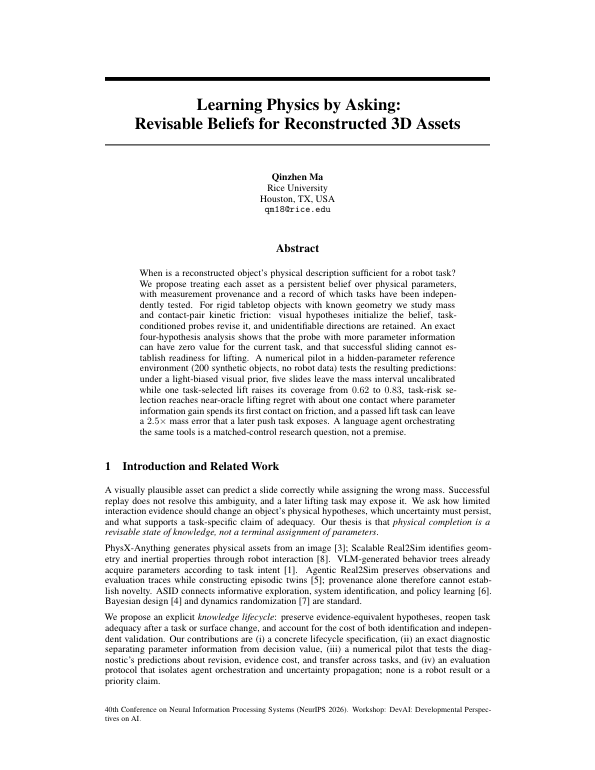
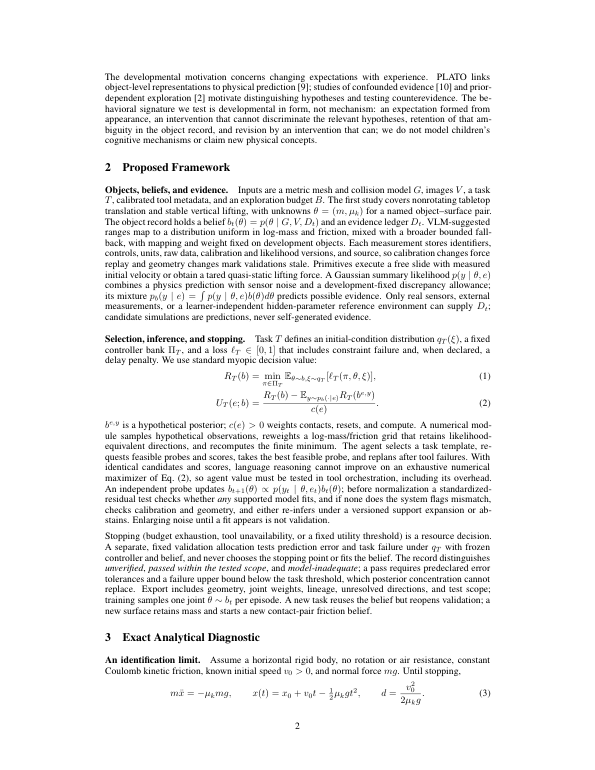
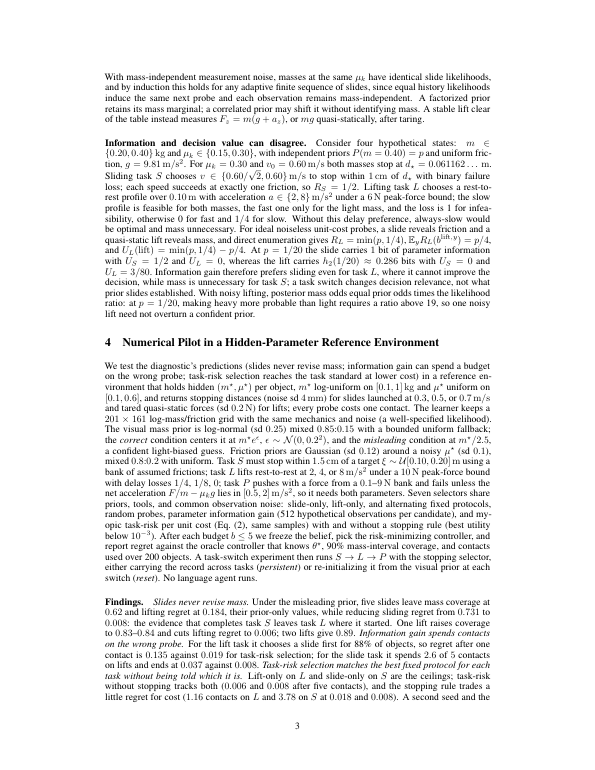
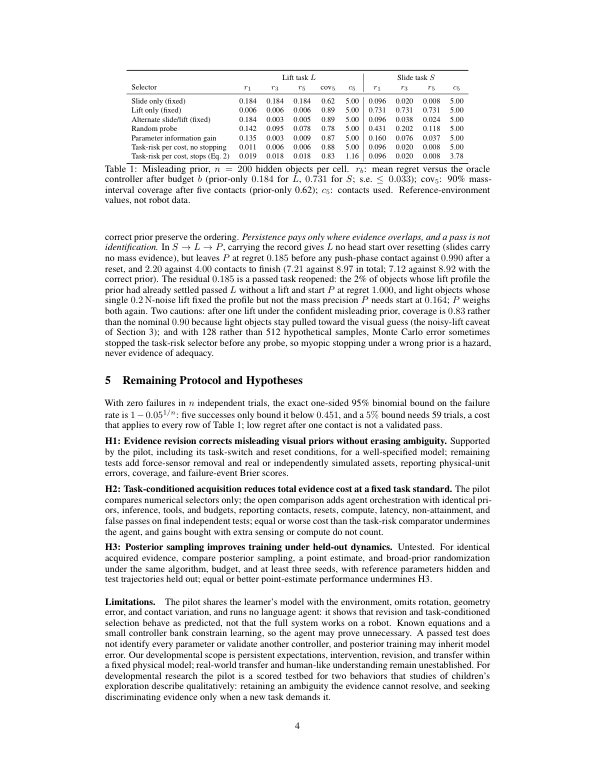
When is a reconstructed object's physical description sufficient for a robot task? We propose treating each asset as a persistent belief over physical parameters, with measurement provenance and a record of which tasks have been independently tested. For rigid tabletop objects with known geometry we study mass and contact-pair kinetic friction: visual hypotheses initialize the belief, task-conditioned probes revise it, and unidentifiable directions are retained. An exact four-hypothesis analysis shows that the probe with more parameter information can have zero value for the current task, and that successful sliding cannot establish readiness for lifting. A numerical pilot in a hidden-parameter reference environment (200 synthetic objects, no robot data) tests the resulting predictions: under a light-biased visual prior, five slides leave the mass interval uncalibrated while one task-selected lift raises its coverage from 0.62 to 0.83, task-risk selection reaches near-oracle lifting regret with about one contact where parameter information gain spends its first contact on friction, and a passed lift task can leave a 2.5x mass error that a later push task exposes. A language agent orchestrating the same tools is a matched-control research question, not a premise.
Paper
Download PDF (5 pages)
BibTeX
@inproceedings{ma2026learning,
  title  = {Learning Physics by Asking: Revisable Beliefs for Reconstructed 3D Assets},
  author = {Qinzhen Ma},
  booktitle = {NeurIPS 2026 Workshop on Developmental Perspectives on AI},
  year   = {2026}
}